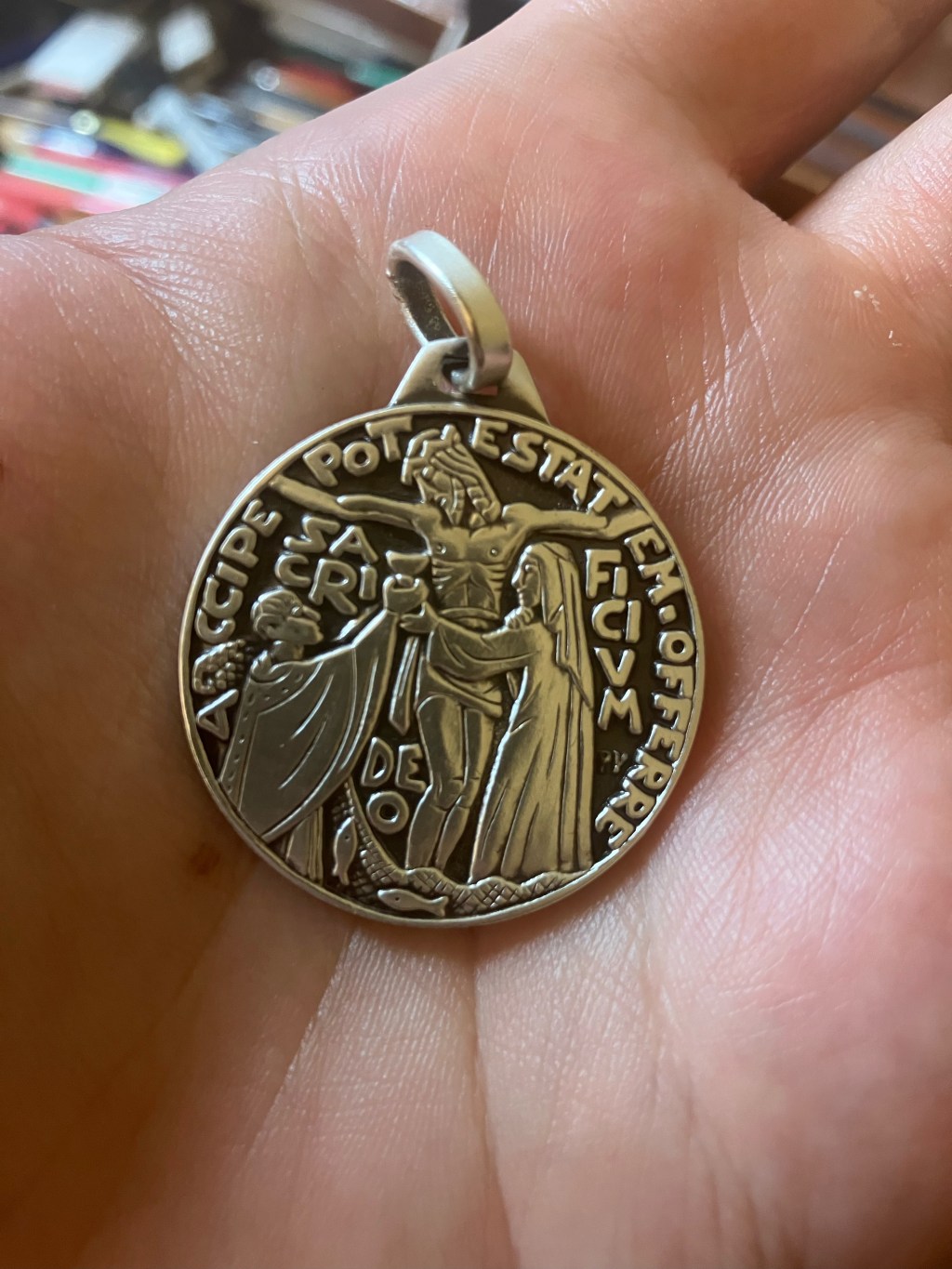
Upon being received as a full member, each Daughter is given a medal indicating her commitment to the practice of a spiritual motherhood for priests and offering to the Lord works of reparation for the sake of the renewal of the priesthood. The medal we chose for ourselves was designed by the French sculptor and engraver, Denis Fernand Py (1887-1949).
The medal features the scene of Jesus’ death on the Cross. The death of our Lord is the inspiration of all Christian sacrifice. The Eucharist is the source and summit of Christian life, as the Second Vatican Council says, because it is the re-presentation of Jesus’ death on the Cross, the sacrifice that reconciles humanity to God and opens up for all human persons the possibility of eternal life.
On either side of the medal are depicted those who collaborate with Christ by receiving and passing on his sacrifice. On the left side is an image of a priest holding up a chalice to receive the blood of Christ as it pours from the pierced side of our Lord. This is a beautiful depiction of the idea mentioned above, that the Eucharistic offering at Mass has an essential relation to the death of Jesus on the Cross. It also depicts powerfully the ancient Christian idea that the sacraments, especially Eucharist and Baptism, originate in the blood and water that flowed from the pierced side of Christ (Jn 19:34; Sacrosanctum Concilium 5). The ministerial work of the priest extends to all the world the reconciliation achieved by Christ in his death. Extending across the bottom of the medal and up over the priest’s shoulder is a net that has already gathered in two fish. This recalls the commission given by Jesus to the Apostles, the first priests, to be “fishers of men” (Mk 1:17) and to “put out into the deep and let down your nets for a catch” (Lk 5:4).
The right side of the medal depicts the Blessed Virgin who is reaching out to help the priest hold his chalice to receive from the open side of her Son. The scene depicted in the medal beautifully captures the idea of the spiritual motherhood of priests that is at the heart of the mission of the Daughters of St. Philip. The Blessed Virgin, the Mother of God, stands by her Son in his suffering, offering her own suffering in communion with his for the sake of the accomplishment of his mission. She also assists and supports the priest in the accomplishment of his vocation to receive the sacrifice of Christ and to celebrate it within the Church for the sake of the salvation of the world. The medal thus depicts the essential features of our Lady’s spiritual motherhood: her fidelity to the sacrifice of her Son and her support for priests.
The medal features a Latin text that reads, “Accipe potestatem offerre sacrificium Deo” (Receive the power to offer sacrifice to God). The words of this text are scattered, as it were, throughout the imagery of the medal, as though embracing in their significance every aspect of what is depicted there. The words of the inscription are taken from the pre-Vatican II ritual for the ordination of priests. They were proclaimed by the ordaining bishop as a kind of instruction to the one being ordained. They were accompanied in the ritual by the gesture of the bishop handing to the ordained man the sacred vessels associated with the celebration of the Mass, the paten and chalice. These are the instruments by which the ministerial work of the priest is accomplished. In fact, these words and the conferral of the sacred vessels were once regarded as the decisive moment when the grace of ordination was imparted to the new priest.
Our medal thus proclaims that the work of the spiritual mother of priests involves having recourse to prayer and acts of spiritual sacrifices to win for priests the grace to remain open to and receive more generously the power first given to them at their ordination. It points beautifully to the mission of the Daughters: that priests may be open to the grace that will transform them into the means by which God transforms countless others.
 The Daughters of St Philip Neri
Leave a comment